

THE SLOT MACHINE ZONE
Beyond the bells, lights and reel is another world-one where players can lose themselves in thought
By Frank Scoblete
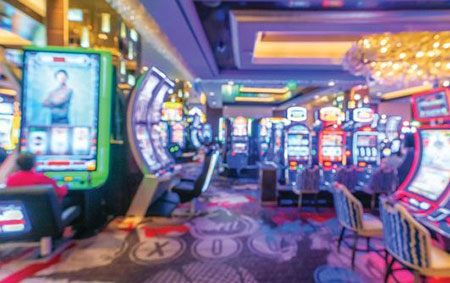 The next time you walk into a casino, do something completely out of character: don’t play. Not yet, anyway.
Instead, take a stroll through the slot aisles. Watch the players. Look at their faces, their posture, their eyes. Pay attention to how little—or how much—they seem to notice the world around them.
I’m proposing a little experiment, and if you play along, you might just see something that supports a theory I’ve been thinking about.
What you’ll probably notice first is that many slot players appear to be somewhere else entirely. They’re focused on the glowing screen in front of them—the symbols, the sounds, the credits going up and down. The casino could be buzzing around them, but their attention seems firmly planted inside the machine. But I think there’s something deeper going on.
For many players, the game itself may actually be only at the front of their consciousness. Somewhere underneath that, in that curious space between being completely awake and mentally drifting away, their minds may be doing something else altogether.
Maybe they’re thinking about a problem. Sorting through a decision. Planning a vacation. Replaying a conversation. Making a mental grocery list. Calming themselves after a stressful day. Or perhaps they’re simply letting their minds wander wherever they want to go.
In other words, maybe the slot machine isn’t just a gambling device. Maybe it’s a modern-day meditation tool.
Now, before you accuse me of spending too much time wandering around casino floors, hear me out.
There’s a wonderful passage in James Clavell’s Shogun in which the protagonist, a British adventurer shipwrecked in Japan, struggles to understand the strange culture around him. He is repeatedly told that he needs to sit and “watch the rocks grow.” Eventually, he follows the advice and spends time sitting quietly in a Japanese rock garden.
And slowly, he gets it.
The point isn’t really to watch rocks. It’s to stop doing anything long enough to let the mind do its own work. The quiet, repetitive focus gives the subconscious room to sort through problems, thoughts and emotions. Now, consider the modern casino.
We don’t have quiet Japanese rock gardens. We have bells, music, flashing lights, celebratory sounds and thousands of machines competing for our attention.
Yet somehow, in the middle of all that noise, many slot players seem to create their own little bubble of solitude.
The casino is roaring. The machine is singing. And the player is somewhere in between. That’s what fascinates me.
I rarely see table-game players become quite so completely absorbed. Blackjack players chat with the dealer and each other. Craps players cheer, groan and high-five strangers. Roulette players celebrate when their number hits—or dramatically lament when it doesn’t.
Table games are social experiences. They have a certain communal energy.
Slots are different.
A slot machine is essentially a private little world. You sit down, choose your game and enter your own universe. In some ways, the slot player resembles a monk meditating in a cave—except the cave has neon lights, sound effects and a potential jackpot.
Psychologists have long studied altered states of attention and consciousness. We’ve all experienced that feeling of becoming so absorbed in something that the rest of the world seems to fade away. Call it meditation, reverie, flow or simply zoning out. Whatever you call it, I suspect plenty of slot players know exactly what it feels like. Maybe that’s one reason they keep coming back.
Sure, they want to win. Of course they do. But perhaps winning isn’t the only reward. Perhaps sitting at a slot machine provides something else: a few minutes when nobody needs anything from you. No emails. No texts. No phone calls. No decisions. No demands. Just you, the machine and whatever happens to be wandering around inside your head.
So the next time you’re in a casino, resist the urge to immediately grab that favorite machine.
Walk the aisles first. Watch the players. Look into their faces. Notice their expressions, their posture and that faraway look some of them seem to have. Ask yourself: Where is that person right now? Are they watching the reels—or are the reels simply giving their minds something to watch while they travel somewhere else?
I’m not suggesting every slot player is entering some mystical state of consciousness. Sometimes a slot machine is just a slot machine—and sometimes we’re simply trying to hit the damn bonus.
But I do think there’s something interesting happening in those aisles. Perhaps the glowing machines aren’t merely taking players somewhere financially. Perhaps, for a little while, they’re taking them somewhere mentally, too.
And maybe that’s a bigger part of the slot machine’s magic than we realize.
Frank Scoblete’s website is www.frankscoblete.com. His books are available at Amazon.com, Barnes and Noble, Kindle, e-books and at bookstores.
