
TRENDING IN SLOTS
Hot game mechanics and grand presentations mark today’s slot floor – but these trends are nothing new
By Frank Legato
 Ever since slot machines became the biggest moneymakers for casinos, the slot experience has been dictated by great ideas from the manufacturers that became trends in game style, game mechanics and game presentation.
In short, the slot-makers see what characteristics draw crowds of players, and those characteristics are duplicated.
Even if patents are filed for slot characteristics, if they’re popular enough, licenses will be issued between slot manufacturers, and those characteristics will proliferate. This has been the case since the first slot boom of the 1980s.
The multi-site progressive was among the first of these new and enduring slot trends, first appearing in 1986 with IGT’s release of Megabucks, the first slot machine to feature a life- changing jackpot as the top progressive prize. Created to allow casinos to compete with life-changing lottery prizes, the big-money progressive today remains as common as the spinning reel.
Another of the earliest slot trends was the multiplying wild symbol. IGT introduced the mechanical reel-spinner Double Diamond in 1989. It was a simple but ingenious concept. The game’s logo was a wild symbol included on each of the three reels. When one landed on the payline in a winning combination, the payoff was doubled. When two landed with a winning symbol, the payoff was multiplied by four. Three wilds on the payline returned the game’s top jackpot.
IGT was the first to repeat this feature. Triple Diamond tripled the jackpot in a winning combination and multiplied the payoff by nine with two symbols in a win. The formula was repeated in kind with Five Times Pay (5X, 25X) and Ten Times Pay (10X, 100X). Today, there are multiple games from most slot manufacturers that include similar multiplying wild symbols. The feature has endured as a staple of slot play, regardless of the other game styles and features that are deployed along with it.
 Coming of the Wheel
Not long after Double Diamond and its sequels came another slot trend that has endured for decades—the bonus wheel.
Bally Manufacturing, the Chicago-based ancestor of today’s Light & Wonder, actually released a game with a spinning wheel back in the 1970s. However, the bonus wheel as we know it today originated in 1995 in another Bally game, called Wheel of Gold. It was a three-reel slant-top slot with a roulette-style wheel mounted on top. Special “spin” symbols on the reels would trigger the top wheel, which would spin to a bonus.
If that sounds familiar, it’s because the wheel on Wheel of Gold was nearly identical to the wheel that would appear a year later from IGT in the legendary Wheel of Fortune, a game that redefined the slot machine. Wheel of Gold was a partnership between Bally and a company called Anchor Gaming. That company, led by inventor Randy Adams, created and patented the bonus wheel, which was licensed by Bally for the game.
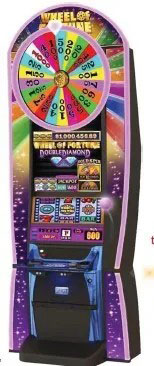
In 1996, a team at IGT licensed the theme, images—and most importantly, the signature audience chant—from the Wheel of Fortune game show to create a game that would launch the era of the licensed slot theme. The slot machine itself—notably, with Double Diamond as the base game—displayed artwork based on the TV show.
However, the central feature was Anchor’s bonus wheel, dressed up to look like the famous wheel from the TV show. A spin symbol on the reels triggered audio of the audience chant from the start of the TV show to kick off the bonus.
 “Wheel… of…. FORTUNE!”
The game-show theme transformed the bonus wheel into a feature that was immediately and wildly popular, making Wheel of Fortune a mega-hit. More than 250 versions of the Wheel of Fortune game have been introduced, with more on the way.
When the game was introduced, Anchor Gaming still owned the patent on the wheel. After a few years of license fees, IGT acquired Anchor Gaming and the wheel patent. Other slot manufacturers clamored to create wheel games of their own, for which they initially paid a license fee to IGT.
Once the patent expired, the floodgates opened on bonus wheels, leading to a variety of wheel-based bonus games that is still growing today.
Hold & Spin—the ‘New Wheel’
In 2014, Aristocrat Gaming introduced the game Lightning Link and its signature “Hold & Spin” game mechanic. A bonus triggered by cash-on- reels symbols would cause those symbols to lock in place while the reels would respin three times. Each new cash symbol returned the number of free spins to three. The bonus continued until three spins without a cash symbol, or until all 15 reel spots showed cash symbols, triggering the top progressive jackpot.
 Call it the “New Wheel.” Just as those slot manufacturers once clamored to create wheel games, slot-makers moved to come up with their own versions of what is generically referred to as the hold-and- spin feature. Competing manufacturers pay into a patent pool for the right to put their own spin, if you will, on the hold- and-spin feature.
These days, most hold-and-spin games are multi-level progressive slots, with the lower-level jackpot icons locking in place along with the cash-on-reels symbols, creating huge bonus payoffs.
Another trend within this trend is a secondary hold-and-spin bonus triggered within the main feature. Landing a special symbol triggers a secondary three-by-three grid on which a mini hold-and- spin feature plays out, with higher cash amounts than the main feature. Often, filling all nine spots triggers a secondary progressive jackpot. Once complete, the game returns to the main hold-and-spin bonus.
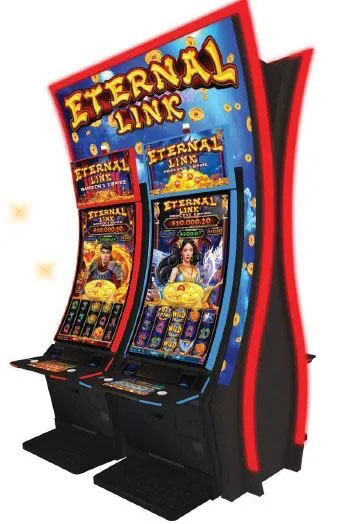
This feature-within-a-feature innovation shows up in slots from several manufacturers. IGT’s Eternal Link offers up a secondary jackpot for the secondary hold-and-spin feature. Other innovations from IGT include Wheel of Fortune High Roller Respin, in which pointer symbols land during the hold-and-spin feature that add pointers to the familiar wheel for a wheel spin with multiple awards.
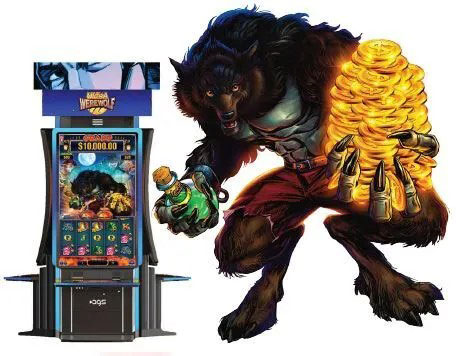
 Other variations on hold-and-spin can be found in games from most suppliers. In Ultra Werewolf Fury & Strike from AGS, the hold-and-spin feature plays out on the first four reels. If symbols fill those four reels, a fifth reel is unlocked that spins to award either a multiplier applied to the accumulated cash (including minor jackpots) or the top Grand Jackpot.
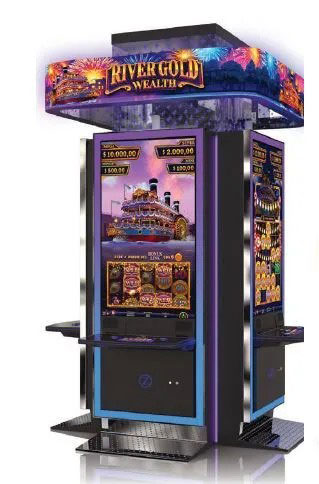
Zitro’s River Gold Wealth features a hold-and-spin event played out on a three-by-five grid with three additional rows locked by festive strings of incandescent light bulbs. Special symbols unlock the additional rows, and unlocking the top row triggers a special River Bonus, a second-screen event that has barges of credit awards and jackpots floating across the screen and granting additional pays.
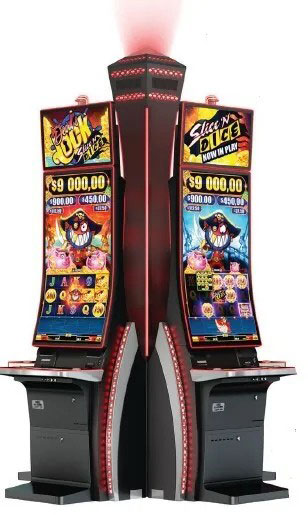
Bluberi’s “Slice & Dice” series features an expanding hold-and-spin feature, starting on a two-by-two grid and expanding to three-by-three, four-by-four and five-by-five, with bonus awards at each expansion.
The hold-and-spin bonus is usually triggered with six or more coin symbols on the reels, but is typically also triggered by another feature that has become commonplace, the “pot collection” feature. Pots—some displayed as pots, but others displayed as pandas, piggy banks, trees or any of a wealth of other icons—are displayed over the reels, and symbols in the primary game send coins up to make the icon bigger (a fat piggy bank, a growing panda). In the trade, they call it a “metamorphic bonus.”
The growing icon is for show. At some random point, a coin will trigger the bursting of the pot, or the piggy bank, and trigger the main hold-and-spin bonus. Normally, each collection pot adds an enhancement to the hold-and-spin round— an extra spin, multipliers, instant awards on cash symbols.
Other games use the bursting pots to trigger free-game, jackpot-pick or other bonuses.
There are many more simple versions of the mechanic, such as the game hosting one of the first appearances, if not the first—Light & Wonder’s 88 Fortunes. Early games like this typically feature a single pot, often represented by a pile of gold coins, triggering a free- spin bonus.
In the vast majority of cases, anticipation builds as the character above the reels grows fatter, the coin pot grows larger, or some other animation makes the player feel like, “one more coin, it’s going to hit.” The truth is that once the level of coins reaches a certain threshold, the pot or pig or piggy bank can burst at any random point.
 Triggers on all of these games can burst two pots at a time, and all of them boast their most generous bonus event when all three pots trigger at the same time, for a triple- enhanced free game or hold-and-spin event.
Some of the manufacturers are now adding funny cartoon game mascots to the mix. They appear randomly to add wild symbols to the reels, to add multipliers, or often, to add bonus triggers to the reels, helping to trigger the bonus by adding the last two or three trigger symbols to reach the required six and enact the hold-and- respin feature.
The hold-and-spin feature isn’t going anywhere, and it’s always interesting to see how the various slot manufacturers craft their own distinct versions of the feature.
Many of these features play out larger than life, thanks to another prominent slot trend of the day— oversized slot cabinets.
Going Big
Casinos always featured one or two novelty giant slot machines on the floor. These were super-sized versions of reel-spinning slot machines. They would be placed as a novelty at the end of a slot bank.
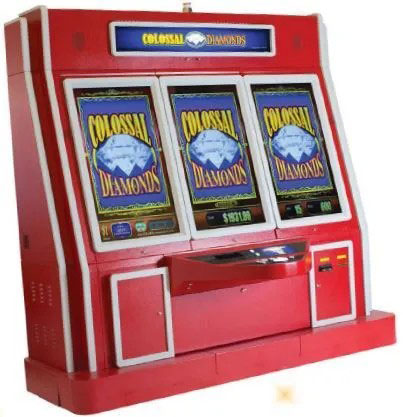
One of the last really popular versions of this kind of novelty game has been Colossal Diamonds by AGS, a massive reel-spinning slot on a cabinet known as “Big Red.”
 For the past decade, though, the slot manufacturers have applied the super-sizing to an increasing number of core and premium slot cabinets. They’re known as large-format cabinets, and these days, every slot manufacturer offers these giant-sized games, often with a bench seat and spin buttons on each side of the button panel.
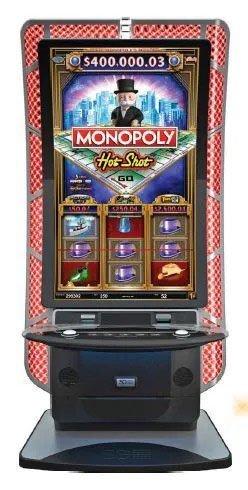
In 2015, Aristocrat launched Big Bang Theory on the Behemoth cabinet, with an outrageously large 84-inch portrait monitor. In 2017, then Scientific Games (now Light & Wonder) released Monopoly Hot Shot on the TwinStar V75 cabinet, with its 75-inch monitor.
That same year, IGT released the CrystalCurve TRUE 4D cabinet, with a 50-inch curved monitor stacked on top of a 27-inch lower screen; Konami launched the Concerto Opus, with its 65- inch monitor; and Everi introduced the Empire MPX, with a 55-inch portrait monitor on top of a 27-inch main screen.
Every year, most of the slot manufacturers introduce a new large-format cabinet, often designed alongside the launch game that will be featured in the new format.
And yes, a lot of those new games have pot collection, and hold-and-spin, and bonus wheels, and multiplying wild symbols. When it comes to slots, everything old is new again.
