

ARE VIDEO POKER MACHINES REALLY RIGGED?
Video poker myths persist, but the odds tell a different story
By Jerry “Stickman” Stich
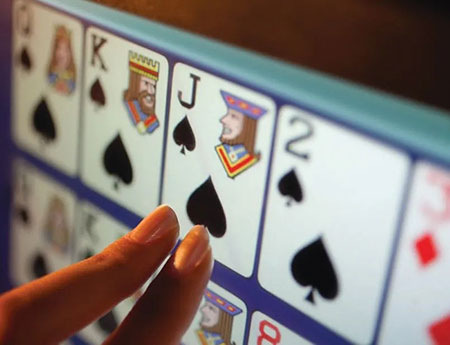 Few casino myths have more staying power than the belief that video poker machines are somehow “fixed.” Many players are convinced casinos manipulate the games so certain winning hands rarely materialize. Among the most common complaints are:
“Whenever I’m dealt three of a kind, I never get the fourth card.” “Four to a flush almost never turns into a flush.”
“Four to an open-ended straight? Forget it—I never complete those.”
“And why does the machine so often replace my discarded card with another card of the same rank?”
So, are these observations evidence that casinos are interfering with the randomness of video poker? Or is something else at work? A closer look at the math tells a different story.
THREE OF A KIND
Suppose you’re dealt three of a kind. After the initial deal, there are 47 unseen cards remaining in the deck, and only one of them completes your four of a kind.
Because you’re drawing two replacement cards, your odds of making quads are about 1 in 23.5. In other words, even when you’re already holding three of a kind, you’ll complete four of a kind only once in nearly 24 attempts.
Add to that the fact that three of a kind is dealt only about once every 424 hands, and it’s easy to see why quads can feel so elusive.
FOUR TO A FLUSH
Players often feel they “never” complete a flush when they’re dealt four suited cards.
In reality, after receiving four cards of one suit, there are nine matching cards left among the remaining 47 cards. That gives you roughly a 1-in-5 chance of completing the flush.
The key phrase, however, is on average.
Probability doesn’t guarantee you’ll make one flush every five attempts. You might miss five, 10 or even 20 times in a row before hitting one. Later, you could complete several flushes back-to-back. Over thousands of hands, the average approaches the mathematical expectation—but individual streaks can feel anything but average.
FOUR TO AN OPEN-ENDED STRAIGHT
The same principle applies to an open-ended straight draw, such as:
4-5-6-7
9-10-J-Q
2-3-4-5
Each of these hands can be completed at either end of the sequence. That means eight of the remaining 47 cards will complete the straight, giving you odds of slightly better than 1 in 6.
Again, players tend to expect the straight to arrive. When it doesn’t, the disappointment sticks in memory far longer than the routine times it does.
DRAWING THE SAME RANK
Another common complaint occurs when a discarded card is replaced by another card of the same rank—for example, throwing away the 3♥ and drawing the 3♥.
While it may seem suspicious, it’s simply another outcome the math predicts. After discarding one card, three of the remaining 47 cards share the same rank, making it about a 1-in-15 occurrence.
Because very little appears to change, these hands stand out in our minds, especially if the replacement card is the same color as the one discarded.
WHY IT FEELS LIKE THE MACHINE IS AGAINST YOU
Human memory isn’t perfectly objective. Psychologists call it confirmation bias and selective recall—we naturally remember unusual, frustrating or emotionally charged events while overlooking routine ones.
Players vividly remember the flushes that didn’t arrive, the quads that fell one card short and the “same-rank” redraws. The many ordinary hands that behave exactly as probability predicts quickly fade from memory.
THE BOTTOM LINE
Video poker machines don’t need to be rigged to produce outcomes that sometimes feel unfair. Randomness naturally creates streaks, clusters and seemingly improbable events.
Over a few dozen hands, almost anything can happen. Over thousands of hands, however, the results closely match the mathematical odds built into the game.
The next time it feels like the machine is conspiring against you, remember: it’s usually not the cards fooling you—it’s the way the human brain remembers them.
