

SINCERE FORMS OF FLATTERY
Imitation has been part of slot-machine development from the very beginning
By Frank Legato
Anyone who plays a lot of different slot machines knows one thing: Slot manufacturers copy each other. If you look at the history of the slot machine, this is not new.
These days, the copying centers on certain types of popular game features, but there’s nothing nefarious about imitating features like pot-collection bonuses, hold-and-spin games, cash-on-reels setups, floating “win zones,” features within features, and other popular game mechanics. In fact, a lot of it is through a formal agreement among the manufacturers. (More on that later.)
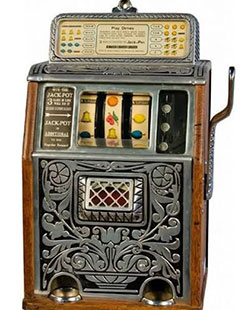 Actually, to trace the history of this phenomenon requires traveling back to the very first device that one would identify as a slot machine. In the late 19th century, saloons in San Francisco offered what you might call primal versions of gambling devices.
There were two forms that were prominent. One looked like an ornate piece of furniture with a huge wheel in the center. These generally operated as mechanized roulette games. The other was a primeval bartop poker machine. About the size of a breadbox (for those who remember breadboxes), it housed a spindle on which five miniature decks of cards would spin for a nickel, resulting in a poker hand. (Of course, many had 50-card decks, with two important cards missing—the early house advantage!)
What we know as a basic slot machine—three spinning reels, various winning symbols, a handle to spin the reels—first appeared in 1895. Charles Fey, a German-born mechanic, created it in his workshop and sold many to San Francisco saloons, where he personally serviced and maintained the machines.
The machine was called the “Liberty Bell.” Reel symbols were lucky horseshoes, playing card suits, and the famous bell. Three bells on the payline sent 50 cents worth of nickels through a mechanized payout device.
(Incidentally, the nickel required to spin the reels, and the coin slot where it was placed, led the machines to be called “nickel-in-the-slot machines,” eventually shortened to “slot machine,” a term that survives today—even though there’s no coin slot.)
While Fey’s Liberty Bell was very popular, he could not patent it. Since gambling was still officially illegal, the U.S. would not issue patents for gambling devices. That meant anyone could copy the design without worrying about a lawsuit.
Within a decade, Herbert Mills did just that. He ran Mills Novelty Company in Chicago, which produced vending machines and jukeboxes. In 1906, he released the “Mills Liberty Bell,” a direct copy of Fey’s machine, right down to the brand name. There are varying stories on its origin, but the official account of the Mills company was that Mills collaborated with Fey on the design.
Regardless of whether or not Fey was involved, the Mills Liberty Bell was a hit, and the Mills company produced them for decades—the first Chicago manufacturer of slot machines—to be followed famously by Bally Manufacturing Company and Williams, making the Windy City the first hub of slot machine production.
And even if Fey was involved, the Mills Liberty Bell was the first and most famous incident of copying slot features.
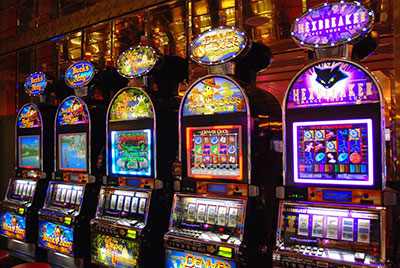 Fast forward a few decades, to when Bally was the undisputed king of the slot machine business. In 1964, Bally launched Money Honey, the first electro-mechanical slot machine—the first game to feature lighting behind the reels and top box, and the first to use a stepper motor to spin and stop the reels, instead of springs and gravity.
By the early 1970s, casinos had rows and rows of three-reel Bally slots, all similar in appearance. Bally even produced a game in 1971 that featured a primitive bonus wheel embedded in the top box.
By the time Bally slots became computerized with the advent of the “virtual reel” electronic system of determining reel results with a random number generator, there was a new competitor in the market, Universal Entertainment of Japan, which flooded the market with three- reel slot machines that closely resembled the Bally slots.
That crucial decade of the 1980s would see developments that are still being copied today—IGT video poker being the main one. William “Si” Redd actually developed video poker while working for Bally. Bally passed on the idea, and Redd formed the company that would become IGT to market the new video poker.
The subsequent decade would bring the most-copied slot feature of all time—the bonus wheel. First appearing in the Wheel of Gold game by Bally in 1995,IGT would seize on the idea the following year with the first game to carry an entertainment theme, and arguably the most popular game in history—Wheel of Fortune. IGT acquired the patent for the wheel feature along with Anchor Gaming, the company that first produced it. For years, any company that wanted to produce a game with a bonus wheel had to pay a royalty to IGT. Once the patent expired, everybody produced wheel games.
Another much-copied game format was the Australian-style multi- line video setup, introduced in the U.S. by Aristocrat in 1995 and copied by Williams (subsequently WMS, now part of Light & Wonder).That copy was related to the IGT patents. Williams released several reel-spinning games in the 1990s, and after IGT sued to enforce its patents, Williams turned to Australian-style multi-line video in 1997 with the game Reel ’Em In. It was a smash hit, and Williams beat Aristocrat to the largest U.S. slot market, Nevada, where Aristocrat would not be licensed until 2000.
Before you knew it, multi-line video slots were everywhere, and IGT soon dominated that market.
But in the 2010s, Aristocrat would produce the most-copied slot feature outside of the wheel with Lightning Link, and its trademark “Hold & Spin” bonus. Pot-collection features would follow in popularity, and today, the two features are typically linked together. Every major slot manufacturer now has its own version of the hold-and-spin feature, along with collection pots ranging from piles of gold coins to piggy banks, pandas and beyond.
So, with all the copying today, why aren’t the lawsuits flying? It’s because slot suppliers came to an agreement—everyone wanted the features, and no one wanted litigation. The owners of the most popular features formed what is known as a “patent pool.” All the manufacturers contributing to the pool are free to create hold-and-spin, pot collection and other popular features without fear of lawsuits, and the pool money goes to the patent-holders.
Players don’t generally have any idea concerning ownership of patents, or who is copying whom. They simply love the features, and copied or not, they flock to them.
They say imitation is the sincerest form of flattery. In the slot business, that principle has applied since day one.
