

SAY IT WITH A SIGNAL
At the blackjack table, your hands can speak louder than words
By Al O’Grady
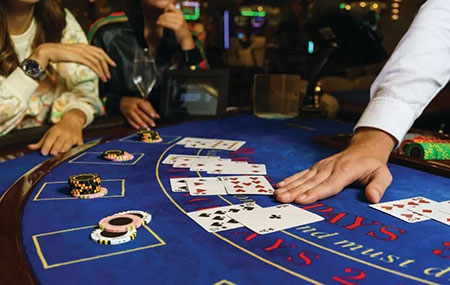 As an experienced dealer, it’s easy to assume players know the basics. But never assume. Every now and then, you’ll get a rookie at the table who knows the goal is to get as close to 21 as possible without going over—but may not know how to ask for another card.
That’s where communication comes in. And at the blackjack table, communication is done with your hands.
Verbal cues alone don’t count. If you want a card or want to stand, you need to use the appropriate hand signal. The signals for hitting have a few variations, and most, if not all, are accepted in casinos.
The original hand signal for hitting is the scratching method. Place your hand face down on the table behind your bet, with your knuckles slightly bent. Imagine you’re holding a computer mouse. Now move your fingers together as if you’re scratching the table. That’s the traditional signal for asking for another card.
Another variation—and the one I prefer—is the tap method. Just tap the table behind your bet. It’s simple, clear and leaves little room for ambiguity. More experienced players may use the pointing method, which is exactly what it sounds like: Point your index finger at your cards. If you’re new to blackjack, I recommend sticking with the tap method until you’re comfortable at the table.
Now, what if you have a good hand and don’t want another card? Standing, also called “sticking,” has two common hand signals.
The first is the waving motion. With your hand three to six inches above the table, move it horizontally as if you’re giving a karate chop. One important caution: Don’t make this motion directly over your bet, especially if your hand is close to the table. You could draw unnecessary attention from the dealer or pit boss. Someone skilled at sleight of hand could potentially use that motion to add chips to a wager, a move known as capping a bet. There’s no reason to invite extra scrutiny, so keep the motion above the table but away from your chips.
The other common signal is the stop-sign method. Simply hold your hand above the table with your palm facing the dealer, as if you’re a traffic cop stopping a car. Both signals work fine in my experience, although some casinos may specifically ask players to use the waving motion. House rules can vary.
So, what happens when you want to double down or split? There is no official hand signal for either action. In these situations, your chips do the talking.
If you have a hand such as 10 or 11 and want to double down, simply place an additional wager equal to your original bet beside it. No other hand signal is necessary. The dealer will understand that you’re doubling down and will give you one additional card.
The same goes for splitting a pair. If you’re dealt a pair of 8s or aces, for example, place an equal wager next to your original bet. The dealer will recognize that you want to split and will proceed accordingly.
That doesn’t stop some players from getting creative. I’ve seen the reverse-clapping method, where a player brings both hands together and then pulls them apart, and I’ve seen players extend their index and pinky fingers behind their bet to signify a split. While these gestures may suggest what the player wants to do, they aren’t official signals and aren’t necessary. When it comes to doubling down or splitting, the chips do the talking.
Here’s an interesting anomaly: What happens if a player verbally says “hit” but gives the stand signal? Hand signals take precedence. The dealer would follow the stand signal and disregard the verbal request. So be careful about sending mixed messages.
Of course, there’s an exception to every rule. Earlier, I said verbal cues are meaningless— and generally, that’s true. But there is one situation where the dealer may need to rely on what you say.
Let’s say you’re dealt a pair of 4s and the dealer is showing a 6. You place an equal wager next to your original bet. Are you splitting or doubling down? The dealer will ask you to clarify, and in this situation, your verbal response will be acted upon.
It’s unlikely the dealer would need clarification if you were dealt a pair of 5s, primarily because you generally don’t split 5s. You would treat the hand as a 10 and potentially double down depending on the situation. Still, a dealer may ask for clarification if the player is a novice or has been playing erratically.
If you’re wondering why blackjack relies so heavily on hand signals in the first place, there are several reasons. Las Vegas casinos attract players from around the world, and language barriers can sometimes make verbal communication difficult. Hand signals provide a universal way to communicate.
More importantly, hand signals help eliminate disputes between the player and dealer. If everything were communicated verbally, a player could claim after a hand was completed that they intended to hit when the dealer understood them to be standing. With clearly defined hand signals—and surveillance cameras recording the action—there is a record of exactly what the player indicated.
So, if you’re new to blackjack, remember: Learn the hand signals, use them clearly and consistently, and know that your hand signal takes precedence over what you say. Good luck at the tables—and don’t forget to tip your dealer!
Al O’Grady has been a blackjack dealer for over seven years. He is a freelance writer with an economics degree and is currently pursuing a degree in mathematics
