

HHR AND THE LAW
Historical horse racing constitutes a growing segment of the gaming machine market-but legal challenges persist
By Frank Legato
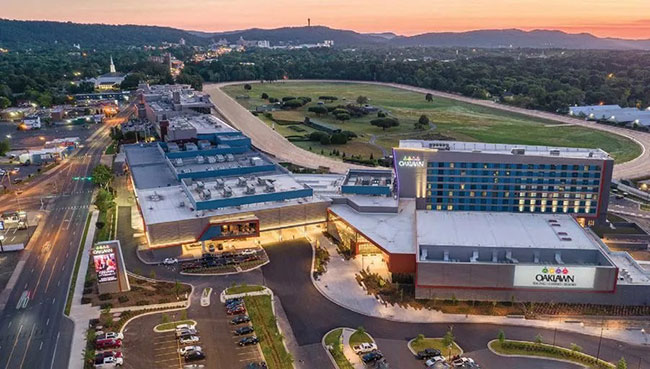
One of the fastest-growing segments of the slot business lately has been the historical horse racing genre, or HHR machines. First utilized at Arkansas’ Oaklawn Park in 2000, these are gaming machines that allow wagering on the results of anonymous past horse races, and display those results as wins or losses in a slot-machine format. They are mostly found in states where casino slot machines are illegal, as a way to support the racing business.
Early HHR machines centered on the races. Players were shown information on horses, jockeys, track conditions and other factors, and placed wagers on three horses. The wagers are placed into a parimutuel pool, just like wagers on horses at the track. The odds may change as a result of the wagers in the pool.
Players have the option to watch the actual race in a video window, but the main attraction has been the central display of spinning reels on a slot screen, with the winners communicated to the player in the form of a reel result.
The technology has vastly improved over the past two decades, to the point where the play experience on an HHR machine mirrors closely the experience of playing a video slot—so much so, in fact, that slot manufacturers now sell many of their most popular video slot themes in the HHR format.
There are now eight states in which HHR machines have been introduced, most states having passed laws to specifically permit their use. They have arguably saved the racetrack operations where they have been placed, providing a vital revenue stream to prop up racetracks in an industry that is struggling to survive, as its traditional market dies off and not enough younger gamblers view the Sport of Kings as their grandfathers did.
Despite the success of HHR, there have been ongoing concerns about the legality of the machines. For instance, the Kentucky Supreme Court ruled against a particular style of HHRs in 2020 because they didn’t pool customers’ wagers from identical horse races. The HHRs showed three separate historical races to players, all incognito. The HHRs placed bets from multiple players into a shared pool, but because the races were separate, the wagers didn’t meet the definition of parimutuel betting.
Opponents of HHR point to the fact that the newer machines have an “auto-select” feature that automatically selects horses for each race. Several state officials have said that the absence of any wagering on specific horses makes the HHR machines operate exactly like slot machines.
Proponents point to a betting system that meets the definition of parimutuel wagering, just as Class II slot machines meet the definition of electronic bingo wagering. In both systems, what players see on the reels is simply a report of the results of the race or bingo game, presented in the familiar format of a video slot game.
Growth in the historical horse racing market will depend on how lawmakers and attorneys general consider these points going forward.
In January, California became the eighth state to add HHR machines to a track setting, and the experiment was short-lived. On Jan. 17, somewhere around 20 agents from the California Department of Justice descended upon Santa Anita Park in Arcadia and seized 26 HHR machines, branded “Racing on Demand,” along with the cash inside the machines, and removed them from the facility.
The seizure came just two days after the terminals were installed. The installation had not been formally cleared in advance with the California Horse Racing Board.
Over those two days, the HHR machines reportedly processed about $26,600 in bets.
In California, it’s not just the state attorney general acting to prevent HHR gaming—some 63 Native American tribes have casino gaming, and many of their leaders have opposed the machines. California law grants tribes exclusive rights to operate slot machines, and tribal leaders say HHR machines exploit a loophole in that law that poses competition to the gaming operations of sovereign Indian nations.
Santa Anita’s owner, The Stronach Group, insists the machines are legal. Stronach officials point out that the HHR terminals rely on a wagering format that was approved by regulators in 2024 known as a “three-by-three” bet, which requires players to select multiple trifecta outcomes. Again, opponents point to the auto-bet feature that negates player selection.
The issue in California will ultimately be decided by the courts. State officials say they will destroy the machines after a 30-day holding period, absent a court order. Santa Anita owners have vowed to battle the action in court, and will likely seek an order staying further action by the state.
For slot players, it’s a matter of convenience. With HHR, they can enjoy the best game families the slot manufacturers have to offer, without having to travel to another state to play. For racetrack owners, the machines are a lifeline that has enabled the continued operation of live racing, with purses that are competitive thanks to the machine revenues.
Ironically, the arguments of HHR opponents are similar to those levied against the Class II electronic bingo model, which has enabled many tribes to achieve income that never would have been possible without the games.
It will be interesting to see how this debate plays out in the tribal gaming hub of California.
